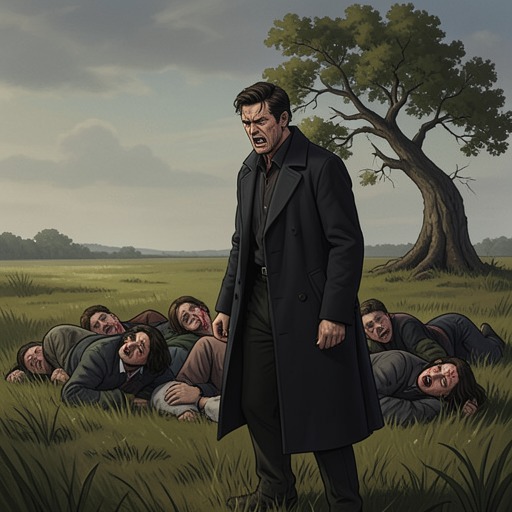
Oscar Brown's Sligger Egg Theft
Secret InvasionOscar Brown's Sligger Egg Theft occurs during a group search for Sligger nests along a watery shoreline. While the other hunters aim to find and destroy the eggs, Oscar secretly takes two for himself, conceals the act, and then draws the group to the nest he has altered. The episode’s central reversal is quiet but consequential: the group believes it has located a nest to destroy, while Oscar privately treats the eggs as something to possess.
The Search and Its Competing Aims
The hunters move through shallow, wet terrain, sometimes wading in water two feet deep. Oscar’s jeans are soaked from the knees down, and his sneakers are saturated with silty water; he accepts the discomfort because the search offers a chance to find Sligger eggs. The group keeps conversation to a minimum so it will not attract the creatures. Its stated priority is to locate and destroy nests, with killing Sliggers a secondary objective. Oscar, however, has a separate aim: he wants to take a couple of eggs for himself.
He walks at the front beside Molly Foster, hoping to spot a nest before anyone else does. The group’s collective attention frustrates that plan, so Oscar suggests that the hunters spread out to cover more ground. His proposal has a practical explanation, but the narration also makes clear that he wants distance from the others. Molly agrees only cautiously, warning him not to get too far away. The exchange places his private objective inside a search whose success depends on cooperation and keeping the group together.
Finding the Eggs
After hearing a rustle and briefly checking the swaying grass, Oscar moves on. Several minutes later, his flashlight picks out pale, pasty objects clustered beneath the reeds. He recognizes them as Sligger eggs like those he had seen on television. The discovery is a group of six, each roughly a foot long and greenish yellow. The eggs are concealed by the vegetation, in the kind of shoreline cover the searchers are traversing.
Oscar opens his backpack and reaches for an egg while Molly, about thirty feet away, asks whether he has seen anything. He ignores her. The text stresses both his excitement and the secrecy of his action: he picks up one egg, finds its surface bumpy and leathery, and is surprised by its weight. He puts it in his pack, then takes a second and puts that away too. The backpack is the concrete means by which the eggs leave the nest, and the two objects he selects match his earlier intention to take a couple for himself.
Concealment and the Remaining Nest
Only after hiding the eggs does Oscar turn back toward the group. He announces that he has found eggs, presenting the discovery without revealing that he has already removed two. The others hurry over, where they see a small nest holding four football-sized eggs. The sequence makes the change in the nest legible: Oscar first sees six, takes two, and the group arrives to find four. The account does not describe the others noticing the missing eggs or suspecting him.
Molly prepares to blast the remaining eggs with her shotgun and praises Oscar for finding them. He thanks her and beams, but the narration specifies that his apparent triumph is not the one she assumes. Her approval belongs to the public version of events, in which he has helped the group locate a nest; his private satisfaction comes from having retained two eggs. The contrast depends on what the group can see—the four eggs still in the nest—and what Oscar has hidden in his backpack.
Significance Within the Sligger Crisis
The search takes place against a spreading threat: Denise has warned that distant attacks indicate multiple nests and creatures along the coast, with further casualties likely. The eggs are therefore not incidental objects but part of an active infestation the hunters are trying to contain. Separately, Denise’s account of tissue analysis and residue from the Nazi U-boat beneath Wrecker Island connects the creatures’ mixed marine characteristics to suspected genetic mutation. These wider facts establish why finding and destroying eggs matters, without demonstrating what becomes of the two Oscar takes.
The theft reverses the group’s immediate purpose at the point when it seems to have succeeded. The hunters locate a nest, but their discovery is already incomplete: two eggs have been removed before they arrive. Oscar’s concealment allows him to participate outwardly in the extermination effort while privately acting against its aim. The scene ends not with an acknowledged confrontation or a stated outcome for the stolen eggs, but with his unexplained smile—a small, telling separation between the group’s apparent victory and the one he believes he has achieved.